I have no idea of the airfoil I should use, nor of the right incidence of my wing.
Airfoil selection, based on polar curve ( Cl / Cd ) analysis is indeed not an easy task. If you want to go into deep analysis, the databases and texts of M. Hepperle and M. Selig are a very useful source of both information and inspiration. In this quest, you may use the Re indicated by SPP to help finding a suitable airfoil.
However, if you do not want to bother with airfoil selection, simply choose an airfoil widely used on commercial or contest models that have approximately the same size and flight style as your model.
Inspiration from existing similar models is also a good strategy for wing and tailplane incidences (meaning the angle the airfoil makes with fuse axis). These angles could be calculated from theoretical formulae, but wing wake and tailplane vertical position have some further effects that usually make such computation partly inaccurate, and thus relatively useless. If you cannot find any data on wing incidence to inspire from, rules of thumb for classical airfoils would be 0 to 3 deg. of positive incidence on a plane (relatively to the fuse longitudinal axis), and 1 to 4 deg. on a glider, provided that the tailplane is at 0. Within these ranges, choose a value according to the principle that the faster the model is intended to be, the lower the value of incidence should be (with the exception of pure aerobatic models that often have 0 incidences to improve inverted flight).
The following note should be added : the effective angle here is the difference of incidence between wing and tailplane. Thus a wing at 3 deg. with a tailplane at 0 is the same as a wing at 5 deg. with a tailplane at 2 deg. The only difference between these two settings will be the attitude of the fuse in level flight, which will appear more nose-down in the second case.
In all cases, do not worry too much about wing incidence, as you will always have the possibility to trim the elevator to some extent in flight.
Last but not least, if your plane tends to climb strongly at full throttle, do not necessarily think about decreasing the wing incidence : try to increase the nose-down angle of the motor first.
How do I test the CG in flight ?
As explained in the previous paragraph, nose-up or nose-down attitude of the fuse in level flight does not directly depend on CG position, but rather on the incidence of lifting surfaces (wing and tailplane). Therefore, how can you test the CG of your aircraft ? The answer is rather straightforward, as soon as one remembers that the position of the CG has mainly consequences on flight stability. If the CG is far enough forward of the aerodynamic center, the model automatically compensates for the pitch perturbations of the flight trajectory. On the other hand, if the CG is too close to the aerodynamic center (CG limit), the model will become less stable, i.e. perturbations of level flight are not corrected.
Thus, testing the CG is easy : trim your model for straight level flight (constant gliding slope for a glider, horizontal flight with half throttle for a plane), let it fly for some distance, and then give a short nose-down order to the elevator. The attitude of the model will change, simulating a trajectory perturbation. What you should look at is what happens next : if the model comes back smoothly to level flight on its own, the CG is ok. If the model continues to fly downward, it means that it does not compensate for the perturbation, and that you should move the CG a bit forward. On the other hand, if the model comes back very quickly to horizontal flight, you might move the CG a bit backward (but always watch the CG limit !).
Why does SPP not compute the Max speed of my plane ?
One way to compute max flight speed would be to know the thrust force produced by the propeller, and to compare it with the drag force of the plane. Unfortunately, computing precisely the thrust force at various flight speeds is not easy, and would imply that you enter several more parameters about the motor and propeller you plan to use. As we want to keep the SPP page simple, we choosed not to compute thrust force. But we are currently working on a way to estimate max flight speed, based on input power only. Moreover, we are also working on another spreadsheet dedicated to thrust computation ...
Can I design a flying wing (FW) with SPP ?
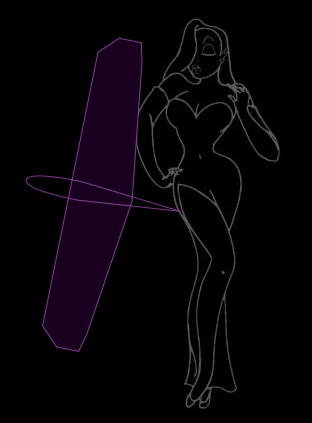
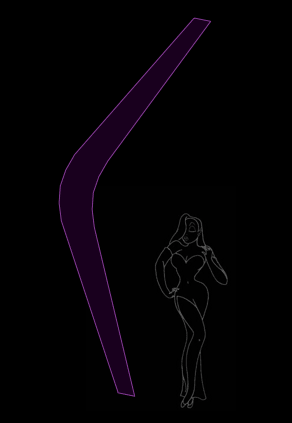
To design a FW (i.e. a plane or glider without a tailplane), you just have to enter "0" in all tailplane dimensions input fields (cords, span and sweep). You will see in the output that Tailplane ratio is not calculated (of course : it's a FW ! ), but that CG rear limit and Static margin are nevertheless computed. As FWs must have a more forward CG than usual aircrafts, you will need to set the CG entry at 15 to 22% of wing MAC (rather than 33% ) to get a positive static margin (3 to 10% Static margins are usual values on FWs). As you see, SPP can be very useful to find the right CG for pitch stability of a FW.
However, this is not enough to guarantee that the FW will fly properly. Indeed, you also need to select an airfoil specially designed for FWs, and design an adequate wing planform. As rules of thumb, plank (unswept) FWs usually need a significantly reflex-cambered airfoil (positive Cm0), as well as a relatively low wing aspect ratio (usually below 8). On the other hand, swept wings work best with slightly reflex-cambered airfoil (slightly positive Cm0), but need a strong sweep (10 to 30 deg.) and washout (i.e. tip cord incidence must be lower than root cord incidence, usually by 2-8 deg.). Swept FWs can have higher aspect ratio than plank wings (usually up to 15), provided that Re does not go to low (see below).
For all FWs, remember that reflex-cambered airfoils develop less lift than usual airfoils. Thus, for glider FWs, best results are often obtained with lower wing loading than usual aircrafts (or the FW will fly too fast). Moreover, reflex-cambered airfoils especially dislike small cords : keeping Re above 100000 is a good idea on these aircrafts.
As SPP does not take reflex-cambered airfoils into account for in-flight performances, nor washout and sweep effects on lift and drag, flight speed and glide ratio outputs as they stand will be significantly biased for FWs. However, CG, static margin, wing loading and power computation, as well as SPP sketch remain usefull tools for designing your next FW. For choosing the right airfoil or computing the best sweep, aspect ratio and washout, please refer to well known flying-wing websites such as M. Hepperle, B2Streamlines, NurflugelTeam or AeroDesign.
By the way, if your FW has a fuse, you may use the lever arm entry to draw a fuse outline in the sketch window.
|
|
| a 140 cm plank wing | a 340 cm swept wing |